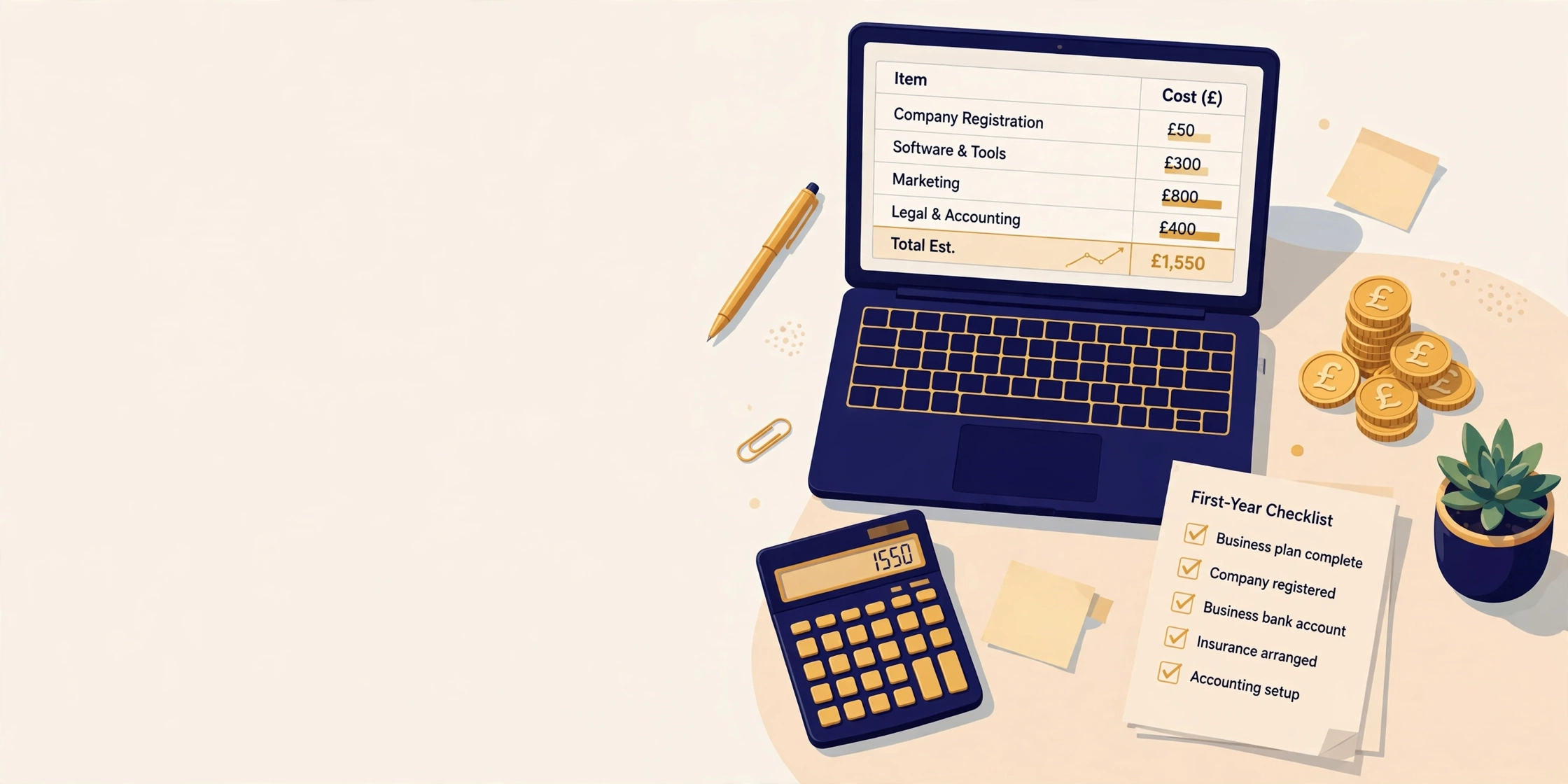
Asking “how much does it cost to start a business in the UK” is the right question, but most guides answer it with a vague range like “£1,000 to £10,000” and stop there. That does not help you plan.
The honest answer is this: in the 2026/27 tax year, you can legally register and launch a home-based freelance business in the UK for around £150 to £400 in setup costs, plus roughly £50 to £100 a month in running costs. An e-commerce business typically needs £3,000 to £10,000 in its first year. A bricks-and-mortar shop rarely costs less than £30,000 to £50,000 in year one. Every figure below is broken down so you can build your own budget.
This guide gives you what no other page gives you: a worked first-year budget template with current 2026 figures, broken down by business profile, plus a month-by-month operating plan and a compliance calendar so nothing ambushes you later. All figures are for the 2026/27 tax year. Verify current amounts with gov.uk and HMRC before you spend.
The Short Answer: What a UK Startup Really Costs in 2026
Every business has three kinds of cost. One-off setup costs (registration, equipment, deposits), monthly operating costs (software, insurance, rent), and compliance costs (tax returns, filings, penalties if you miss them). Here is how they stack up for three realistic UK business profiles in year one.
| Cost block | Freelancer / service (home-based) | E-commerce (home-based) | Bricks-and-mortar shop |
|---|---|---|---|
| Legal registration | £100 | £100 | £100 |
| One-off setup | £150-£500 | £1,000-£3,000 | £8,000-£20,000 |
| Monthly operating costs | £50-£100/month | £150-£300/month | £2,500-£5,000/month |
| Compliance and filings, year one | £0-£50 | £0-£150 | £200-£600 |
| Realistic year-one total | £1,500-£2,500 | £3,000-£10,000 | £35,000-£75,000 |
These totals exclude your own wages and the income you need to live on. You will need a personal survival budget alongside the business budget, which we cover below.
If you are brand new to business finance, read our business finance for beginners UK guide first for the foundations, then come back here for the numbers.
The Mandatory Legal Costs: What Every UK Business Pays
Before anything else, know what the law requires. Some of these are free. Some are not.
Registering a limited company. Incorporating online with Companies House costs £100 from 1 February 2026. The fee was £50 until February 2026, so older guides are out of date. Paper incorporation costs £124. Registering for corporation tax with HMRC is free, but you must do it within three months of starting to trade.
Registering as a sole trader. Free. You register for Self Assessment with HMRC online and there is no fee at any stage. This is the cheapest legal route to trading, which is why many freelancers start here.
Director identity verification. Under the Economic Crime and Corporate Transparency Act, identity verification is now mandatory for company directors and people with significant control. As of November 2025, new directors must verify at appointment. Verifying directly through Companies House using GOV.UK One Login carries no separate charge.
The annual confirmation statement. Every limited company must file one each year to confirm its details are correct. The digital filing fee is £50 from February 2026. Your first confirmation statement falls due roughly 12 months after incorporation, so most new companies pay this late in year one.
Employer obligations. If you employ anyone, employers’ liability insurance is compulsory by law (minimum £5 million cover). There is no way around this cost, and fines for trading without it are severe. Budget £100 to £300 a year for a very small team, more as you grow.
The bottom line on legal costs: a limited company costs £100 to create and about £50 a year to keep compliant with Companies House, before tax filing costs. A sole trader costs £0 to register. Everything else below is a business choice, not a legal requirement.
One-Off Setup Costs: Registration, Brand and Equipment
Setup costs are the money you spend once, before you earn a pound. Keep them lean.
Domain name. A .co.uk domain typically costs £10 to £20 a year from a UK registrar. A .com usually costs £12 to £25. Prices move, so check at the time of purchase. Buy the domain before someone else does.
Website. Options range from £0 (a free page builder tier) to £60-£150 a year for basic hosting plus a template. E-commerce needs a platform subscription, typically £25 to £40 a month for a starter plan. Check current pricing on the platform’s site, as these figures change.
Branding. A professional logo from a freelance designer costs £150 to £500. Many founders start with a clean template design for £0 to £50 and upgrade later. This is a vanity cost in month one. Spend it only if your business visibly sells on image.
Equipment. This is the wild card. A freelancer may need nothing beyond the laptop they own. A photographer might need £2,000 of kit. A shop needs fit-out, which can run £3,000 to £10,000 for a modest unit. Only buy what generates revenue.
Deposits and premises. Commercial premises usually demand a deposit (often one to three months’ rent) plus the first month’s rent upfront. Small high-street units in the UK often let at £500 to £2,000 a month depending on the town, so budget £1,500 to £6,000 in deposits and advance rent. Many retail leases also require a legal fee contribution of £500 to £1,500.
Professional help. An accountant for a new limited company typically charges £600 to £1,200 a year for year-end accounts and tax returns. Some founders handle bookkeeping themselves in year one and bring in an accountant later. If you do, budget the fee anyway so it does not arrive as a shock.
For a step-by-step method to organise all of this, see our guide on how to create a business budget.
Monthly Operating Costs: The Bills That Never Stop
Running costs are the true test of a startup. A business dies when monthly outgoings outlast the cash, not when setup was expensive. Here are the recurring costs to budget for every month.
| Monthly cost | Typical range (2026) | Who pays it |
|---|---|---|
| Accounting software | £15-£30 | Almost every business |
| Business insurance | £8-£50 | Businesses with clients, stock or premises |
| Phone and broadband | £20-£60 | Everyone working from home or on the move |
| Website and platform fees | £0-£40 | Any business trading online |
| Marketing and advertising | £50-£500+ | Optional in month one, essential by month three |
| Rent and utilities | £0-£2,000+ | Only if you have premises |
| Stock and materials | Varies | Product businesses only |
| Staff wages and payroll | Varies | Only if you employ people |
Accounting software. Cloud packages like Xero, QuickBooks or FreeAgent cost roughly £15 to £30 a month for a basic plan. FreeAgent is free for some business bank account holders, so check before paying. Prices change regularly, so confirm current pricing on the provider’s website.
Business insurance. A home-based sole trader with public liability cover typically pays £60 to £180 a year. A small retailer combining public and employers’ liability usually pays £350 to £650 a year. These are indicative 2026 figures; your trade, turnover and claims history move the quote.
Marketing. The most underestimated cost in every startup budget. You do not need £500 a month on day one, but plan for it. Organic marketing (content, local listings, referrals) costs time instead of money, which matters when cash is tight.
Worked Example 1: Freelancer or Service Business
Profile: A marketing consultant working from home as a limited company. No staff. No stock. One laptop already owned.
| Month | What you pay | Amount |
|---|---|---|
| Month 1 | Companies House digital incorporation | £100 |
| Month 1 | Domain (.co.uk) + basic hosting | £70 |
| Month 1 | Public liability + professional indemnity insurance | £150 |
| Month 1 | Accounting software (annual paid monthly) | £25 |
| Month 1 | Home working costs (broadband share, phone) | £40 |
| Month 2-12 | Accounting software | £25/month |
| Month 2-12 | Home working costs | £40/month |
| Month 3+ | Marketing (portfolio site upkeep, networking) | £50/month |
| Month 12 | Confirmation statement (may fall in year 2 depending on dates) | £0-£50 |
Year-one total: roughly £1,500 to £2,000, excluding any new equipment. Notice how small the mandatory costs are. The £100 incorporation fee is the only truly unavoidable payment. Everything else scales with ambition.
The danger for this profile is not setup cost. It is cash flow. If clients pay on 30-day terms and your first invoice takes six weeks to settle, you need savings to bridge the gap. Our guide to cash flow management for small business explains how to build that bridge.
Worked Example 2: E-Commerce Business
Profile: An online store selling homeware, run as a limited company from a spare room. Stock bought upfront.
| Month | What you pay | Amount |
|---|---|---|
| Month 1 | Companies House digital incorporation | £100 |
| Month 1 | Domain + e-commerce platform subscription | £45 |
| Month 1 | Initial stock order | £1,500 |
| Month 1 | Packaging and shipping materials | £100 |
| Month 1 | Product liability insurance (annual) | £200 |
| Month 1 | Product photography (DIY kit or freelancer) | £100 |
| Month 2-12 | Platform subscription | £35/month |
| Month 2-12 | Packaging and postage (variable with sales) | £80/month |
| Month 2-12 | Marketing (social ads, marketplace fees) | £150/month |
| Month 6 | Stock reorder | £1,000 |
Year-one total: roughly £5,000 to £8,000. Stock is the dominant cost, and it is also the dominant risk. Order too much of the wrong product and the money sits on a shelf. Start with a small range, prove what sells, then reorder.
E-commerce has one more cost category: fees. Marketplaces and payment processors take a percentage of every sale, typically 2 to 10 percent depending on the platform. These come out of revenue, so build them into your pricing from day one rather than discovering them in month four.
Worked Example 3: Bricks-and-Mortar Shop
Profile: A small independent coffee and gift shop on a secondary high street, limited company, two part-time staff.
| Month | What you pay | Amount |
|---|---|---|
| Month 1 | Companies House digital incorporation | £100 |
| Month 1 | Deposit (2 months) + first month rent (£1,200/month) | £3,600 |
| Month 1 | Lease legal fees | £800 |
| Month 1 | Shop fit-out (paint, shelving, signage, till) | £6,000 |
| Month 1 | Business rates deposit / first payment | £300 |
| Month 1 | Insurance (public, employers’, stock) annual | £600 |
| Month 1 | Initial stock | £2,000 |
| Month 2-12 | Rent | £1,200/month |
| Month 2-12 | Staff wages (2 part-time) | £1,800/month |
| Month 2-12 | Utilities, card terminal, phone | £250/month |
| Month 2-12 | Stock replenishment | £500/month |
| Month 2-12 | Accounting software + accountant (pro-rata) | £90/month |
Year-one total: roughly £50,000 to £65,000. Wages and rent dominate, and they are due whether customers come or not. This is why the first-year budget for a physical business is really a survival calculation: how many months can you cover the fixed costs before revenue catches up?
One relief to check: small business rate relief. In England, occupied properties with a rateable value up to £12,000 can qualify for 100 percent business rates relief, tapering up to £15,000. This has saved many new shops thousands of pounds a year. Relief rules change and differ across the UK nations, so check your council and the current rules for the 2026/27 year.
Your First-Year Compliance Calendar: The Costs Nobody Warns You About
Starting a business is cheap. Staying compliant has a calendar, and missing dates is expensive. Here are the deadlines a new limited company must track in year one, all current as of the 2026/27 tax year.
| When | Obligation | Cost if done right | Cost if missed |
|---|---|---|---|
| Within 3 months of trading | Register for corporation tax with HMRC | Free | Penalties from HMRC |
| When turnover passes £90,000 | Register for VAT | Free | Backdated VAT bill |
| 12 months after incorporation (+14 days) | File confirmation statement | £50 digital | Company can be struck off |
| 9 months after year end | File annual accounts (first year: 21 months after incorporation) | Accountant fee or DIY time | Automatic £150 penalty |
| 9 months + 1 day after period end | Pay corporation tax | 25% main rate, 19% small profits rate on profits up to £50,000 | Interest and penalties |
| 12 months after period end | File CT600 corporation tax return | Included in accountant fee | £200 penalty for returns due on or after 1 April 2026 |
Sole traders have a simpler calendar: register for Self Assessment when you start, file your tax return online by 31 January after the tax year ends, and pay what you owe by the same date. VAT registration applies to sole traders too once turnover passes £90,000.
Corporation tax rates are 25 percent for most companies and 19 percent for companies with profits up to £50,000 in the 2026/27 tax year. Confirm current rates and thresholds with HMRC, as these are political decisions that change. For planning how tax fits your year, see our tax planning strategies for small business owners.
Hidden Costs Most First-Time Founders Miss
These are the costs that sink budgets because nobody budgets for them.
Your personal survival budget. The business budget covers the business. You still need to eat. Add up your personal bills for six months and keep that separate from business money. Founders who mix the two end up starving the business or the household, usually both.
Slow-paying customers. Your budget assumes invoices get paid on time. Many do not. Budget as though your biggest client pays 30 days late, and chase invoices the day they are due. This is why an emergency fund matters; read our guide to building an emergency fund for your business.
Renewals at full price. Domain registrars, software trials and insurance policies often renew at a higher price than the introductory deal. Put every renewal date in your calendar and shop around before it renews.
Deposit creep. Landlords, suppliers and payment processors all hold deposits. None of them are huge. Together they can lock up thousands of pounds of working capital you thought was available.
Compliance fees for professional help. That accountant fee of £600 to £1,200 a year is real money in year one. So is the £200 late-filing penalty if you skip the accountant and get the accounts wrong.
Growth costs. Winning more customers costs money: more stock, more ads, maybe your first hire. A budget that only covers survival will break the moment you succeed. Revisit the budget every quarter.
How to Build Your Own First-Year Budget in 5 Steps
You now have the figures. Here is how to turn them into a working budget.
Step 1: Pick your business profile. Use one of the three worked examples above as your skeleton. Add or remove lines to match your reality. A tradesperson adds a van and tools. A consultant adds professional subscriptions.
Step 2: Separate setup from monthly costs. Setup costs happen once and you can often fund them from savings. Monthly costs repeat forever and must be covered by revenue. Never fund recurring costs with one-off money and hope for the best.
Step 3: Add a 20 percent contingency. Something will cost more than you expect. A 20 percent buffer on setup costs is not pessimism, it is realism.
Step 4: Build the month-by-month view. List months 1 to 12 down a page. Put each cost in the month it lands. This shows you the months where cash goes negative, which is the whole point of the exercise. A spreadsheet works; our business budget guide walks through the method in detail.
Step 5: Review quarterly. Your budget is a living document. Every three months, compare actual spending to the plan, find what drifted, and update the remaining months. Businesses that review their budget quarterly spot trouble in time to fix it.
If you want to understand what the numbers mean once money starts moving, our guide on how to read and analyse financial statements will help you read your own accounts like an investor would.
Funding Your Startup Costs: Where the Money Comes From
Most UK founders fund year one from personal savings, and that is fine for a £2,000 freelance setup. For bigger launches, know your options.
Personal savings. The cheapest funding there is. No interest, no approval, no debt. But do not empty your emergency fund. Keep at least three months of personal bills untouched.
Government Start Up Loans. The UK government’s Start Up Loan scheme lends £500 to £25,000 per applicant at a fixed 7.5 percent APR over one to five years, with no arrangement fees and 12 months of free mentoring. It is an unsecured personal loan for business purposes, open to founders aged 18 or over who are starting out or have traded for under five years. If your setup costs sit between £1,000 and £25,000, this is often the cheapest formal borrowing available. We have written a full walkthrough of how government startup loans work and how to apply.
Friends and family. Common, and commonly awkward. If you take money from people you love, write down the terms: amount, repayment schedule, and what happens if the business fails. Verbal agreements destroy relationships.
Bank loans and credit cards. Standard business loans usually need trading history you do not have yet. Credit cards fund plenty of startups but at punishing interest rates. Compare carefully; our comparison of business loans vs personal loans breaks down the trade-offs.
Never borrow to cover costs you have not budgeted. Borrowing is fine when it funds a plan. It is dangerous when it funds hope.
FAQs: Cost of Starting a Business in the UK
Can I start a business in the UK with £1,000? Yes, if it is a home-based service business. Registering as a sole trader is free, a limited company costs £100, and a domain plus basic insurance costs under £300. £1,000 covers a lean freelance launch with money to spare. It does not cover stock, premises or staff.
What is the cheapest way to legally start a business? Register as a sole trader with HMRC. It is free, takes minutes online, and you can start trading immediately. You file one Self Assessment return a year. Upgrade to a limited company later when the tax or liability picture justifies it.
How much does it cost to register a limited company in 2026? £100 if you incorporate digitally with Companies House. That fee took effect on 1 February 2026; older guides quoting £50 are out of date. Paper incorporation costs £124.
Do I need an accountant in my first year? Not legally, but strongly recommended for limited companies. Year-end accounts, the CT600 and corporation tax calculations have real penalties for errors. Budget £600 to £1,200 a year. Sole traders with simple affairs often manage with software alone.
What are the ongoing costs of a limited company? At minimum: the £50 annual confirmation statement, accounting software (£180 to £360 a year), and accountant fees (£600 to £1,200). Insurance adds £100 to £600 depending on your trade. Expect £1,000 to £2,000 a year in fixed compliance and running costs before you spend a pound on growth.
How much should I budget for marketing in year one? Plan for at least £50 to £150 a month from month three onwards, in money or in serious time spent on organic marketing. Businesses that budget £0 for marketing usually discover in month six that nobody knows they exist.
Can I claim startup costs back as tax deductions? Many pre-trading expenses are allowable against your first year’s profits, including registration, equipment and professional fees, provided they were incurred wholly and exclusively for the business. Keep every receipt from day one. The exact treatment depends on your structure, so confirm with an accountant.
How much emergency cash should a new business hold? Aim for three to six months of fixed costs in reserve. For a freelancer that might be £300 to £600. For a shop, £10,000 to £20,000. Our emergency fund guide explains how to build this without starving the business.
Is it cheaper to be a sole trader or a limited company? A sole trader is cheaper to run: no incorporation fee, no confirmation statement, simpler accounts. A limited company costs roughly £1,000 to £1,500 more per year in compliance costs. The company structure can still be worth it for tax efficiency and limited liability once profits grow. Run the numbers for your situation rather than following a rule of thumb.
What is the biggest hidden cost for new businesses? Time. Founders routinely work 60-hour weeks for months before the business pays them. That is a real cost, paid in savings and stress. The second biggest is slow-paying customers, which is why invoicing discipline matters from the first invoice.
Do I need business insurance on day one? If you have employees, employers’ liability insurance is legally required from day one. Otherwise, buy public liability or professional indemnity cover as soon as you meet clients, visit sites, or sell products. A home-based consultant can often wait a few weeks; a shop cannot open without it.
When do I need to register for VAT? When your VAT-taxable turnover exceeds £90,000 in a rolling 12-month period. Registration is free and done online with HMRC. You can also register voluntarily below the threshold, which sometimes makes sense if your customers are VAT-registered businesses.
Conclusion: Start With the Budget, Not the Business
The cost of starting a business in the UK is not one number. It is a budget with three parts: setup, monthly running costs, and compliance. Build all three before you spend anything, add your 20 percent contingency, and review the budget every quarter.
For most home-based founders in 2026, the honest year-one figure is £1,500 to £2,500 plus living costs. For e-commerce, £3,000 to £10,000. For a physical shop, £35,000 to £75,000. Those are real numbers with real 2026 fees behind them: £100 to incorporate, £50 a year for the confirmation statement, free registration for sole traders and VAT.
The founders who get this right are not the ones with the most money. They are the ones who knew where every pound was going before it left.
*This article is general information about UK business costs, not financial advice. Figures are for the 2026/27 tax year and change regularly. Verify current fees and tax rates with Companies House, HMRC or gov.uk, and consider speaking to a qualified accountant before making financial decisions.*
About the Author